Flatweave or Loop Pile: Two Constructions, Two Jobs
Flatweave has no pile and is reversible. Loop pile holds an edge and resists crushing. Which construction fits the traffic, measured not guessed.
The Calm Finds editorial desk · Published Sep 28, 2026 · Updated Oct 1, 2026 · 6 min
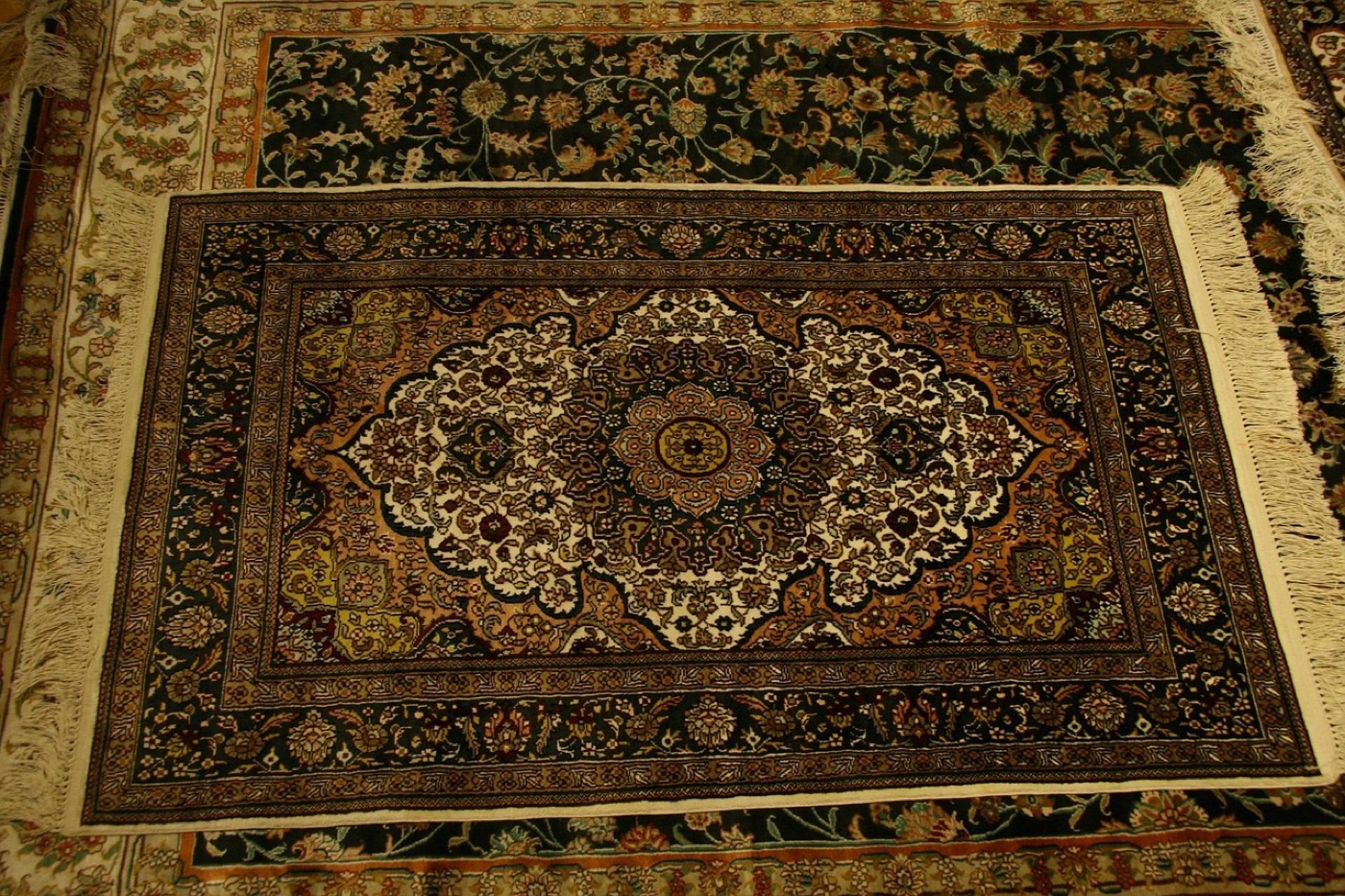
These two constructions are frequently described as a soft-versus-durable choice. They are not — they are two different mechanisms, and the mechanism decides the room.
What each one is made of
A flatweave is interlaced warp and weft with no tuft layer at all. The pattern is produced by the weave itself, through colour changes in the yarn or by techniques such as slit weaving or wrapping. Nothing stands up, which is why a flatweave lies flat enough to roll, folds without a crease memory, and has a total thickness usually under a quarter inch. Loop pile is a foundation with yarn drawn up through it in continuous loops, anchored at both ends and left uncut. The loops stand at a stated height, commonly in the low-to-medium bands, and the same figure that means something modest on a cut pile means a visibly textured surface here.
| Flatweave | Loop pile | |
|---|---|---|
| Pile | None | Uncut loops, usually 3–8 mm |
| Thickness | Under 6 mm | Backing plus loop height |
| Edge | Crisp, selvedge or bound | Held upright by the loops |
| Reversible | Usually | No |
| Underfoot | Firm, minimal cushion | Soft, resilient |
| Shows weave irregularity | Yes | Partly hidden by the loops |
What the structure does
Flatweave. With no pile to compress, there is nothing for a chair leg to sink into and nothing to mat down. A dining chair rolls across it instead of catching, which is why the construction is standard in dining rooms and why hallway pile height is usually specified as a flatweave or a low loop. And because the back mirrors the front, the rug can be turned over, which effectively doubles the life of the visible face.
The cost of that honesty is that a flatweave cannot hide anything. Every join where the weaver changed yarn and every slight variation in tension is on the surface, because there is no tuft to bury it. A visible line along a length of flatweave is a real feature of the structure, and whether it reads as character or as a flaw is a judgement about the piece. Ask for a photograph of the reverse before buying, and check whether the pattern is direction-dependent.
Loop pile. The loops are anchored at both ends, which is why this construction holds its edge. There is no cut tip to fray, no loose end to work loose, and nothing for a vacuum to pull at — the loops lie flat against the foundation, so loop pile vacuums cleanly and stays presentable in a busy room. It resists crushing rather than yielding to it, so a traffic path wears in appearance before it wears through. It also barely sheds, for a mechanical reason: a loop is never cut, so there are no cut ends to release.
What it does not do is lie flat. A loop pile rug is thicker, heavier, and unforgiving of a rippled subfloor. It is also not reversible, and it is the more likely of the two to mark a soft wood floor under a heavy leg.
Choosing between them
Choose by traffic and by floor, in that order. For a dining room, entryway, hallway, kitchen, or stair landing, a flatweave or a low loop pile: neither has a tip that abrades first, neither crushes into a path, and both clean without extraction. For a bedroom, dressing room, or sitting room that is walked through rather than lived in, loop pile — the cushion is the point, and the surface stays presentable longer.
Note that thin rugs need a pad more often than thick ones do, because there is less mass to hold position — the pad specification is covered in the measurements to take first. And check the terminology before you buy: the spec vocabulary uses overlapping words for these two structures, and a page that says only “woven” has not told you which one you are getting.
Frequently asked
- Is a flatweave as durable as a pile rug?
- In high-traffic areas, often more. A flatweave has no tufts to crush, mat, or abrade at the tips, and published construction guidance treats it as the most forgiving construction available. What it gives up is cushion, acoustic absorption, and the ability to hide a defect in the weave.
- Are flatweave rugs reversible?
- Usually. Because there is no pile layer, the back is a mirror of the front and the rug can be turned to use the other face, which roughly doubles the useful life of the surface. A pattern woven with a directional or one-sided element, such as a slit weave with a colour change running only one way, is the exception.
- Does a loop pile rug need an underlay?
- More often than a flatweave, not less. Loop pile is usually heavier and denser, and a dense wool loop on a soft wood floor can concentrate enough point load under a furniture leg to mark the finish. A quarter-inch pad spreads that load and slows the abrasion of grit trapped between rug and floor.